


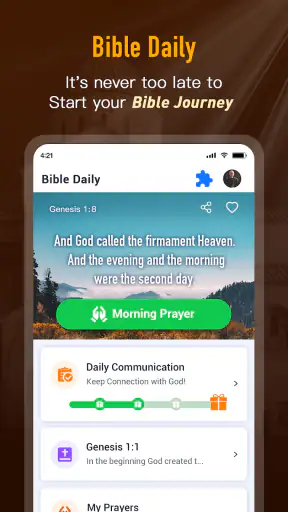

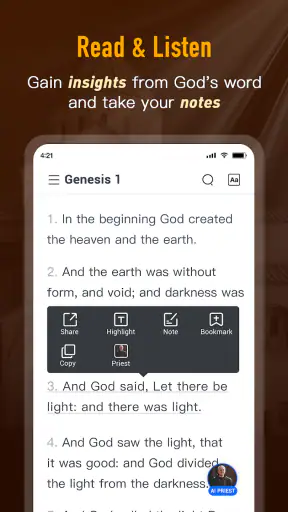



I spent time with Bible Daily, KJV Bible + Audio as a practical reading companion rather than treating it like a simple digital book. It is a free Books & Reference app from WOOMBIT, built around the King James Bible, offline reading, guided prayers, Bible trivia, reading plans, and an AI Priest feature. That combination makes it more useful than a bare text viewer, although it also means the experience depends on whether you want a traditional Bible text or a more guided, feature-rich routine.
My first impression was that the app is aimed at people who want to keep scripture close throughout the day without carrying a printed volume. The KJV translation gives it a distinctly traditional tone, while the surrounding tools make it feel more like a daily devotional app. I would recommend it to someone who wants structure and variety around Bible reading, not necessarily to someone looking only for the fastest possible way to search a verse.
How I used Bible Daily in a normal routine
Starting with a simple reading habit
The most reliable way to use Bible Daily is to begin with one repeatable action: open the app, choose a passage, and read without immediately jumping between every extra feature. The KJV text is the center of the experience, so I found it helpful to treat the other tools as support rather than as replacements for reading.
A realistic everyday routine would be reading a short passage with morning coffee, returning to the same section later through offline access, and ending the day with a prayer prompt or a few trivia questions. This approach makes the app feel less overwhelming. If I opened it with the intention of trying everything at once, the Bible text could become secondary to browsing menus.
Offline reading is particularly useful for a commute, travel, or a quiet place where a connection is unreliable. It also changes the app from something I use only when I have internet access into a dependable reference tool. I would still prepare the passages I expect to read before leaving home, because an offline feature is most valuable when it is part of a habit rather than an emergency discovery.
The audio element adds another option for users who absorb scripture better by listening. I found this more suitable for walking, household tasks, or a reflective break than for detailed study. Listening encourages a different pace, but it is not a substitute for carefully comparing passages, checking cross-references, or taking detailed notes. For those tasks, a dedicated study Bible or a desktop reference tool may be a better match.
Choosing between reading, listening, and guided activities
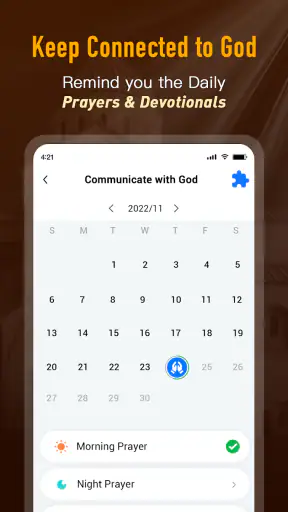
One strength of this app is that it accommodates different levels of attention. Reading works when I want to focus on wording. Audio works when my hands and eyes are occupied. Guided prayers are useful when I want a starting point but do not know how to shape a quiet moment. Trivia adds a lighter review activity after reading.
The trade-off is that these modes do not all serve the same purpose. Trivia can help reinforce familiarity with biblical material, but it should not be mistaken for serious study. Likewise, an AI Priest may offer conversational guidance, yet I would treat its responses as a tool for reflection rather than as pastoral authority. For sensitive spiritual questions, personal circumstances, or doctrinal decisions, a trusted religious leader and the text itself deserve more weight.
I also noticed that the app is more welcoming to users who appreciate prompts than to readers who already have a precise study system. A person who knows exactly which translation, commentary, note format, and cross-reference system they want may find the guided approach less flexible than a specialized Bible study app.
What the basic experience feels like
The app is rated for Everyone, which fits its approachable presentation and broad devotional purpose. It does not feel designed only for experienced Bible scholars. A new reader can start with a plan, a prayer, or a selected passage instead of having to understand a complicated research workflow first.
At the same time, the KJV is not the easiest translation for every modern reader. Its older vocabulary and sentence patterns can slow down someone encountering scripture for the first time. That is not a flaw in the app itself, but it is an important choice. If clarity in contemporary English is your main priority, another Bible app with several modern translations may serve you better.
The app has reached over five million installs and holds a 4.7 average from around forty thousand ratings, which suggests that its blend of reading and devotional tools appeals to a substantial audience. I would not use popularity as proof that it fits everyone, but it does make the app feel like an established option rather than an obscure experiment.
Settings I would check before settling in
Experienced users should spend a few minutes reviewing the available reading and audio preferences before building a routine. The most useful settings are the ones that reduce friction: text presentation, reading behavior, audio controls, and notification choices where available. Even a small adjustment can determine whether I read consistently or abandon the app after a few sessions.
I prefer a text size that lets me read comfortably without forcing constant scrolling. For longer passages, a clean layout matters more than fitting as much text as possible on screen. A slightly slower reading pace can also be worthwhile when listening, especially if the goal is reflection rather than simply finishing a chapter.
Notifications deserve deliberate attention. A reminder can help establish a daily pattern, but too many prompts can make a personal practice feel like an obligation. My advice is to begin with one predictable reminder, connect it to an existing habit, and change it if it becomes easy to dismiss. The best reminder is not the most frequent one; it is the one that arrives when I genuinely have time to read.
Audio should be tested in the setting where it will actually be used. A voice that feels comfortable during a quiet morning may be less suitable in a noisy commute. I would also keep headphones and battery use in mind during longer listening sessions. Offline access is helpful here, but I would still avoid assuming that every part of the app behaves exactly like a downloaded audio library.
Using plans without turning them into a race
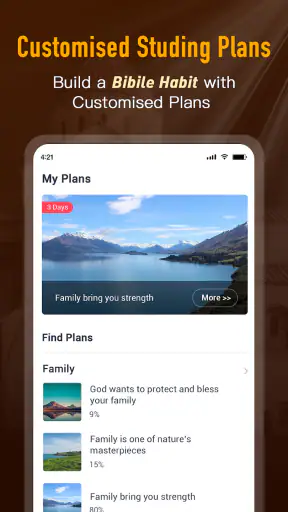
Reading plans are one of the better ways to give the app a sense of direction. I found them most useful when I treated the plan as a suggested rhythm rather than a deadline. Missing a day should not turn the experience into a catch-up burden, especially when the purpose is reflection.
A practical method is to choose a plan that matches the time I can realistically give it, then use the KJV text for the main reading and audio for a second pass later in the day. This creates two different encounters with the same material without requiring a complicated system. If the plan feels too demanding, shortening the session is better than abandoning it completely.
Plans are also useful for people who open Bible apps with good intentions but do not know where to begin. Instead of searching randomly, I can follow a sequence and let consistency do some of the work. The limitation is that a plan may not match a personal church schedule, study group, or preferred order of books, so users with an established curriculum may prefer to use the app as a reference rather than as their main guide.
Faster patterns for returning to familiar passages
The quickest workflow is to avoid treating every visit as a fresh exploration. When I know what I want to read, I go directly to the passage instead of starting with trivia, prayers, or the AI feature. That simple decision keeps the app responsive to my purpose: reading first, extras second.
For repeated study, I would use a small personal routine. I might read the passage silently, listen to it later, and then use a prayer prompt to consider one practical response. This three-stage pattern is more useful than consuming several unrelated features because each step reinforces the same passage from a different angle.
Another efficient pattern is to reserve trivia for the end of a session. Used as a warm-up, it can pull attention away from the text. Used afterward, it becomes a light recall exercise. This is a non-obvious distinction, but it made the app feel more balanced in my own use. The same feature can either support reading or compete with it depending on when I open it.
The AI Priest feature can also be approached with a clear boundary. I would use it to generate questions for reflection, summarize what I am wrestling with, or suggest a way to begin a prayer. I would not let it replace scripture reading, personal discernment, or a conversation with someone qualified to provide pastoral care. Its value is as a prompt, not as the final voice in a serious spiritual decision.
Where the free model fits
Bible Daily is free to install and use, but it includes in-app purchases ranging from forty-nine cents to forty-nine dollars and ninety-nine cents per item. That makes it important to check what is available without paying before building a routine around a particular tool. I would begin with the core reading experience, offline access, and the features that matter most to me, then decide whether any optional purchase genuinely improves my use.
This model can work well for casual readers who want to explore before committing. It may be less appealing to someone who expects every devotional or AI-related feature to be included without limits. The right question is not whether optional purchases exist, but whether the free version already covers the part of the app I came for.
I also prefer not to make a purchase simply because a feature looks interesting on the first day. A week of regular reading tells me more than an initial burst of curiosity. If the app becomes part of my routine and a paid option removes a real obstacle, the expense may feel justified. If I only use the extras occasionally, the free experience is probably enough.
Advanced limits that matter to serious readers
The biggest limitation is the fixed emphasis on the King James Bible. Readers who compare translations, study original-language nuances, or depend on extensive scholarly notes will likely outgrow this app as a primary research tool. It can remain useful for reading and listening, but it should not be confused with a full academic Bible library.
Search and navigation are also important considerations for advanced users. A devotional app can be excellent for a guided sequence while still feeling slower than a dedicated reference app when I need to locate several related passages quickly. If my main task is building a sermon outline, tracing a word through scripture, or comparing parallel translations, I would choose a tool designed around research first.
The AI feature introduces another boundary. Artificial intelligence can respond smoothly and offer helpful prompts, but a confident tone does not guarantee theological accuracy or personal appropriateness. I would avoid sharing highly sensitive personal information and would verify any serious interpretation against scripture and trusted human guidance. This is not a reason to reject the feature; it is a reason to use it with judgment.
There is also a difference between convenience and depth. Offline reading, audio, plans, prayers, and trivia make the app easy to return to, but convenience can encourage quick consumption. I had to make a conscious choice to slow down, reread a passage, and sit with one idea instead of moving continuously from one activity to another.
Who should use it, and who should look elsewhere
I think Bible Daily is a strong fit for someone who wants a free starting point for daily scripture, prefers the KJV, and enjoys having reading plans and devotional prompts in the same place. It also suits users who move between reading and listening during a normal day. Families and newcomers may appreciate the Everyone age rating and the less intimidating entry point.
I would be more cautious recommending it to a reader who wants modern translation choices, extensive commentaries, detailed note-taking, or a highly customizable study environment. Someone who already owns a preferred Bible app may gain little unless the KJV audio, guided prayers, trivia, or AI interaction adds something distinct to their routine.
Compared with a printed Bible, this app is more portable and interactive, but it can also be more distracting. Compared with a basic ebook, it offers more guidance and audio-oriented use. Compared with a scholarly Bible platform, it is easier to approach but less suited to deep research. Its best position is between those extremes: a daily companion rather than a complete replacement for every kind of Bible study.
My verdict after building a repeatable habit
After using the app with a simple pattern of reading, listening, and reflection, I came away with a favorable but measured opinion. Bible Daily succeeds because it gives the KJV a practical daily setting instead of leaving the user alone with a large block of text. The plans and prompts help when motivation is low, while offline access makes the reading habit less dependent on a connection.
My main advice is to keep the workflow intentional. Start with the passage, adjust the settings for comfort, use audio when it genuinely fits the moment, and save trivia or AI prompts for a purpose. The app works best when its extra features support a reading habit instead of replacing one.
WOOMBIT has made a broad, approachable Books & Reference app, and the current version is 1.39. Its strong reception and large user base make it worth trying, especially because the initial price is free. Just remember that the KJV style, optional purchases, AI limitations, and lighter study depth will not suit every reader.
For me, the final recommendation is straightforward: install it if you want a portable KJV with audio, plans, prayers, and gentle interactive guidance. Give it a fair trial using one consistent daily routine before exploring everything else. If your priority is scholarly comparison or a modern translation, choose a more specialized alternative. If your priority is building a sustainable habit around the KJV, Bible Daily is a thoughtful and convenient companion.


